
31 Jul 2026
The Association of Natural Rubber Producing Countries (ANRPC) releases the Monthly NR Statistical Report, June 2026.
Foreword by Secretary-General
It is my honor to present the ANRPC Monthly Natural Rubber Statistical Report for June 2026—a month marked by notable price resilience amid a complex interplay of geopolitical developments, supply-side constraints, and evolving macroeconomic conditions. The provisional reopening of the Strait of Hormuz, following a US–Iran memorandum of understanding, contributed to a sharp decline in Brent crude oil prices, which averaged USD 85.40 per barrel in June—a month-on-month drop of 20.29%—while persistent supply tightening from El Niño-related weather disruptions in key producing regions continued to provide upward price support. The following figures and analysis highlight the principal market developments shaping the natural rubber sector in June 2026.
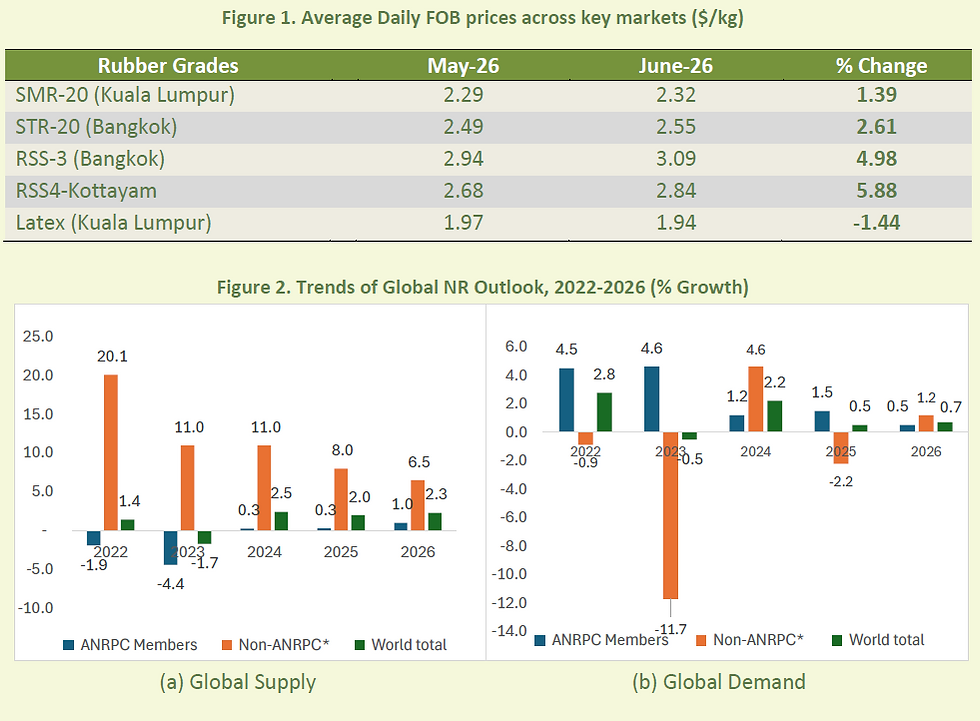
As detailed in Figure 1, physical prices posted broad-based gains across most grades in June: SMR-20 rose 1.39% to USD 2.32/kg, STR-20 gained 2.61% to USD 2.55/kg, RSS-3 advanced 4.98% to USD 3.09/kg, and RSS-4 strengthened 5.88% to USD 2.84/kg, while latex eased 1.44% to USD 1.94/kg—each grade trending higher through mid-month before moderating into the close. On the import side, China rose 7.14% month-on-month, while India (−11.38%) and Viet Nam (−4.65%) declined and Malaysia held steady. On the export side, Cambodia (+32.29%), Viet Nam (+20.99%), and Indonesia (+2.04%) advanced, while Thailand’s exports declined 2.97%.
World natural rubber production is projected to reach 15.310 million tons in 2026, up 2.3% from 14.971 million tons in 2025, led by gains in Thailand, China, India, and Malaysia even as Indonesia and Viet Nam ease (Figure 2a). Monthly output fell to 1,207,000 tons in June (−3.7% year-on-year), reflecting the seasonal wintering period compounded by unusually high temperatures and rainfall disruptions across Southeast and South Asia driven by the ongoing El Niño event; Malaysia, Indonesia, and Cambodia each advanced new incentive, export-governance, and investment measures to strengthen their rubber sectors. Global consumption is forecast to grow 0.7% to 15.411 million tons in 2026, led by China, India, Malaysia, and Cambodia (Figure 2b). June consumption rose to 1.300 million tons (+3.3% year-on-year), led by China (602,500 tons) and India (114,000 tons), supported by steady tyre and EV-linked demand, resilient manufacturing PMIs in China (50.3) and India (54.2), and record auto retail sales in India.
The Malaysian ringgit traded between RM3.96/USD to RM4.08/USD, while the Thai baht traded between 32.56 and 33.24. The SHFE September 2026 contract averaged 17,580.68 CNY/ton (-0.45% m-o-m) and the SGX September 2026 contract averaged USD 2.24/kg (+1.75% m-o-m), both reflecting tightening supply and firm downstream demand.
ANRPC remains committed to providing timely, authoritative, and objective analysis of the global natural rubber market in fulfilment of its mandate as an inter-governmental organization dedicated to the sustainable development of the natural rubber sector. I encourage member governments, industry partners, and all stakeholders to engage closely with the analysis presented in this report and to draw upon these findings in the formulation of evidence-based policies and strategic decisions.
For subscription enquiries or to renew an existing subscription, please contact the ANRPC Secretariat at secretariat@anrpc.org.
Yours sincerely,
Dr. Suttipong Angthong
Secretary-General