19 Aug 2026
The Association of Natural Rubber Producing Countries (ANRPC), hosted by the Rubber Board, Government of India, successfully convened the Sustainable Natural Rubber Forum 2026 on 19 August 2026 at the Crowne Plaza in Kochi, India.
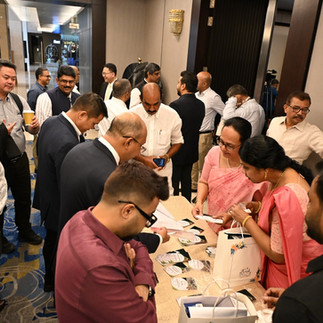
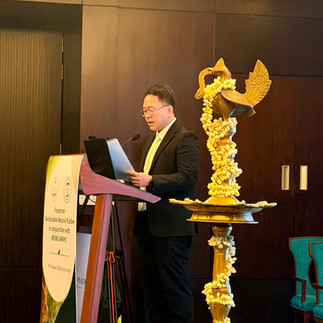
KOCHI, India, 19 August 2026 – The Association of Natural Rubber Producing Countries (ANRPC), hosted by the Rubber Board, Government of India, successfully convened the Sustainable Natural Rubber Forum 2026 on 19 August 2026 at the Crowne Plaza in Kochi, India. The landmark event brought together around 120 stakeholders from ANRPC Member Countries, industry leaders, smallholder organizations, and international partners from Cambodia, India, Malaysia, Thailand, and Europe to chart a transformative path for the global natural rubber sector. Mr. M. Vasanthagesan, Executive Director, Rubber Board, Government of India, and Dr. Suttipong Angthong, Secretary-General, ANRPC, welcomed the participants at the Sustainable Natural Rubber Forum.
Under the theme "Aligning Priorities for Resilient Supply Chain," the forum addressed the converging challenges of climate change, supply chain traceability, regulatory pressures including the EU Deforestation Regulation (EUDR), and rising market demand for verified sustainable materials. The discussions delivered a resounding message: the future of natural rubber depends on unprecedented collaboration across the value chain, with smallholder inclusion as the non-negotiable foundation of any successful sustainability strategy.
With the theme of aligning priorities, the forum addressed the converging pressures of climate change, new regulatory frameworks like the EU Deforestation Regulation (EUDR), and escalating market demand for verified sustainable materials. The discussions underscored a critical consensus: the industry's future hinges on collaborative action, with smallholder inclusion as the cornerstone of any successful sustainability strategy.
Key Forum Outcomes
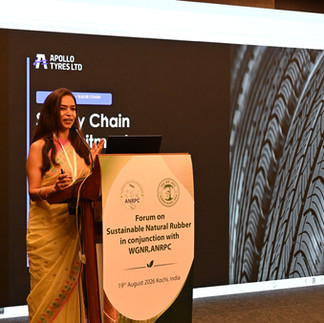
Net-Zero Commitments Gain Momentum Industry leaders emphasized that achieving net-zero requires a fundamental "cradle-to-grave" approach. Ms. Rinika Grover of Apollo Tyres revealed that scope 3 emissions account for over 80% of the tyre industry's total footprint, with upstream emissions approximately 26 times greater than operational emissions. Dr. Satya S. Tripathi of the Global Alliance for Sustainable Planet introduced "regenerative rubber landscapes," noting that plantations on degraded land can achieve carbon emissions as low as 0.5 tons of CO2 per ton of rubber—compared to up to 20 tons on recently deforested land.
National Sustainability Systems Showcase Progress ANRPC Member countries presented significant advancements in their sustainability and traceability frameworks:
India unveiled the Bharat Sustainable Natural Rubber (BSNR) system, the country's first Digital Public Infrastructure (DPI) grade platform, having already mapped over 56,000 hectares with targets of 150,000 hectares by March 2027.
Malaysia reported successful export of 200 tons of EUDR-compliant rubber to the Netherlands in December 2024, with 107,000 smallholders and 30 processors already inspected under its mandatory Malaysian Sustainable Natural Rubber (MSNR) framework.
Thailand positioned EUDR not as a trade barrier but as a catalyst for modernizing its rubber ecosystem through farmer registration, geolocation mapping, and digital traceability platforms.
Cambodia is actively developing a national traceability system, having registered approximately 18,000 producers with 86,000 more in progress across over 400,000 hectares of rubber cultivation.
Smallholder Inclusion Takes Center Stage With smallholders producing 85-90% of global natural rubber, speakers across all sessions stressed that sustainability frameworks must empower, not burden, farming communities. The groundbreaking INROAD Project—a public-private partnership between the Indian government and four tyre companies—was highlighted as a transformative model. With an investment of approximately ₹1,100 crore (USD 130 million), the project has distributed 83 million rubber plants to over 200,000 tribal smallholders and created 300 new nurseries in Northeast India.
Industry Partnerships and Innovation
Case studies from Michelin, Harrisons Malayalam, the Malaysian Rubber Council, and the Global Platform for Sustainable Natural Rubber (GPSNR) presented how shared investment and measurable outcomes are driving resilience. Discussions also focused on positioning natural rubber as a climate-positive material, with significant potential for carbon credits and biodiversity conservation.
Traceability and Technology Drive Transformation The forum showcased innovative solutions balancing technological sophistication with practical accessibility. Trst 01 presented BSNR as a scalable DPI model integrating with India's digital identity systems. The European Forest Institute introduced Wemo ("What is my origin"), a free, open-source traceability application designed specifically to support EUDR compliance with offline functionality for remote smallholder communities.
EUDR Implementation: Practical Pathways Forward Industry and regulatory experts provided critical insights into EUDR compliance. Apollo Tyres and Corrie-Maccoll addressed the value chain process, noting operators face potential penalties of 4% of revenue—not profit—making robust internal systems essential. The German Competent Authority confirmed that initial enforcement will prioritize education over harsh penalties, with no certification scheme providing a "green lane" as operator liability remains primary.
Future Vision for 2030
In the concluding panel discussion moderated by Dr Lekshmi Nair, ANRPC, the policymakers and industry leaders envisioned a transformed sector by 2030 featuring:
A digitally connected natural rubber supply chain
Significantly improved smallholder livelihoods
Natural rubber recognized as a climate-positive material with carbon credit potential
Industry-wide sustainability standards replacing fragmented compliance approaches
Voices from the Forum
Mr. M. Vasanthagesan, Rubber Board of India: "The forum has demonstrated that sustainability is not merely compliance but a powerful opportunity to modernize our sector, improve livelihoods, and position natural rubber as the world's most sustainable industrial raw material."
Dr. Suttipong Angthong, Secretary-General, ANRPC: "No single stakeholder can build resilience alone. The path forward requires shared investment, measurable outcomes, and recognition that smallholders must be central to every sustainability framework we develop."